Friday, 2 May 2008

Raiders of the lost Poppies

My friend Mariangela lives in Rimini.
 
A couple of weeks ago she was travelling to Asti and was going to pass thorugh Bologna. "Are there poppy flowers in Bologna?", she asked me in an email.
 
I read her email while I was in a conference in Genova. Shit, this year I had forgotten all about poppy flowers, I thought to myself! It is our old ritual. When she comes to see me in Bologna we go to look at them.
 
There used to be this old field near our house that would get full of red poppy flowers in April-May. I had been there with Mariangela. They mowed that field down two years ago and since then I hadn't ever seen large expanses of poppy flowers.
 
So I needed to go around and search for some poppy flowers before she came to see me.
 
Red poppy flowers - Image by Sunil Deepak

Poppy or the Pappaverum Somniferum is supposed to be that plant that can be used to make opium. For getting opium you you need the milk of the ripe dry fruit. That is the reason, why you need a special permission to grow poppy plants in Italy. Some people say that to get opium you need another variety of poppy and not these common flowers that we have, that is why no one bothers with these. Perhaps you also need the hotter sun of equator. I am not sure about that but you can usually see the bright red poppy flowers along railway tracks and highways, where it grows as a weed, in our part of Italy.

The black poppy seeds are used commonly as decoration on bread and give off a lovely aroma. I am not sure if those can be recovered from these flowers, I usually buy them in Asian shops.
 
I am going to look for poppy flowers one of these days, I told myself. Finally, today was my the day of operation poppy-flowers.

I decided to go out beyond Ca' Bianca for my morning walk with our dog, Brando, to the part where there are some farm-houses.
 
He is getting old, our Brando, and likes to go over his usual walking routes and usually if I try to pull him in some new directions, he usually does his Angad ji show, pointing his feet and refusing to move. However, today I was in no mood to give in to him and kept on pulling him till he gave in.
 
And today no I-pod, no music to distract me, I decided. Nature demands proper attention or so, I thought. And so off we were. 

Different Kinds of Seeds

Just out of the house, and I got distracted by the Maple seeds. There were so many of them hanging from the tree almost like plastic butterflies. So I started looking around clicked the pictures of different looking seeds. Here are some examples. The maple seeds had wings like butterflies flying with acute angles.
 
Maple seeds - Image by Sunil Deepak

In the next picture is what they call "albero falso di Giuda" or the 'false Jude's' tree, with dried beans like seeds. In autumn, these trees without any green leaves and only these dark brown seeds look slightly sinister, and make me think of Dracula myths. I also don't know why they call them false Jude and if there is a real Jude's tree as well?


False Jude's Tree seeds - Image by Sunil Deepak

I like the seeds of Lime trees with the strange wing that is pierced by the flowers. I have read of the subtle perfume of Lime but to me the flowers seem scentless.

Then I saw the Elm tree with round penny like wings holding a small seed in the middle, in the next picture. Though on the tree the seeds are bunched together like piles of pennies and it is not easy to make out the form of individual seed.


Elm seeds - Image by Sunil Deepak
 
And Finally these rounded beans like seeds that look like jhumkas, rounded-bean like seeds that look like women's ear-rings. I don't know the name of this tree.
 
Women's ear-rings like seeds - Image by Sunil Deepak

Roses

Then it was the turn of the roses. There were so many of them in the garden that we passed. Some of the housewives, going about their daily business of dusting and beating the carpets with sticks, looked at me with a suspicion as I tried to get a good angle to click their roses, but they were quickly mollified by the sight of Brando, who can look nice, cuddly and angelic when he is not busy barking at any rival dogs. There are already too many pictures on this post, so I am sparing you my roses-pics today.

Finally the Red Poppy-Flowers

Finally, I did find the poppy flowers finally just a little outside, on the road that goes along the wheat fields. There were not too many of them but enough for taking some pictures.
 
Red poppy flowers - Image by Sunil Deepak
 

Disgusted dog

It was a lovely morning and our morning walk lasted almost one and half hour. Unfortunately Brando didn't appreciate it and seemed a bit annoyed at loosing his rhythm as I forced him to hold still while I clicked pictures of plants and flowers from different angles.
 
The return back to home after the poppy flowers was quick as Brando almost ran, understanding that I had completed my mission, pulling me along! If you think that he is too sweet or cute or small to pull people, you don't know him yet! (In the image below he is with my son)
Our dog Brando and my son - Image by Sunil Deepak

*** 


Tuesday, 29 April 2008

Talking to Altaf Tyrewala

It was January 2008. We were in the north Italian city of Turin for a literature festival organised by an Italian literary foundation, Grinzane. There was a special session in this festival about India and thus many Indian authors were invited. I was there as an Indian blogger and had helped in deciding whom to invite. 
 
I had asked Altaf Tyrewala for an interview and finally we got around doing it during a bus journey as we were going out for some lunch. As we sat down in the bus and I was fumbling with my recorder, Altaf said that he hadn’t liked being presented as a “Muslim writer from India”. I agreed with him completely, I would hate to be called a “Hindu writer from India”. I had had some discussions with the organisers and I knew they did it to refute any charges of ignoring the writers from Indian minorities, but I guess that doesn’t make it any easier!
Altaf Tyrewala in Turin, Italy - Image by Sunil Deepak

He said, "When outside they call me in this way it saddens me. It is not enough that in a nation a minority has to be made self-conscious, even outside the country they are ... they didn’t mention the religious background of any other writer." 
 
Lavanya Shankaran, who was sitting behind us didn’t realise that it was an interview and I was recording it and so she also joined in the conversation. I was very happy since the discussion was very stimulating and I was imagining that my recorder is recording her voice as well. Unfortunately that was not the case, I can only hear some of her words. I vaguely remember what she said but that is not enough to re-construct her part of dialogue and I regret that immensely.

Here are some excerpts from the transcript of that discussion-recording. The symbols are AT for Altaf Tyrewala and SD for me, Sunil Deepak

SD: Tell me about the kind of things you like to read? 

AT: I like reading something that has been stripped to the bare essentials. I am almost incapable of enduring descriptions, etc. Anything that assumes that I don’t know ... I read the internet, I try to remain clued in to the world. What I like to read is something that I can not access as an information. 

SD: You don’t see that as a contradiction, wanting to be a writer and yet wishing to express yourself in as few words as possible? 

AT: (laughs) Yes, absolutely. I think that it is extremely damaging to my career. I won’t be able to churn out books every year. But this is something that I have to deal with as a writer, it is my challenge. This conflicting instinct in me, to speak and not to speak, these are two powerful impulses in me. To keep quiet because whatever has to be said, has already been said, and the other side, even while wishing to keep quiet, to find things to say. 

SD: Writing is a creative expression and there are different ways of expressing creativity. Did you have to choose from different things you wanted to do or was writing the only thing that you wanted to do? 

AT: I have always wondered what it would be like to be a painter or a musician, but writing is something that goes beyond creative expression. It has become a way of life. It is not like an outburst of creative energy. I think that it is almost like it moulds your way of living. I am not a writer just when I am writing, I am a writer 24 hours a day. That is how I have found myself becoming. 

SD: You have written one book that has been published but may be you have written lot of other books that have not been published or that are still in your head. How do you decide what you are going to write and how long that process takes to actually come to do it? 

AT: (laughs) The first novel came out organically. I had this impulse to write, a deep desire and need to write. I was trying to understand how the conventional form of a novel would do justice to the kind of society and I kind of reality I grew up in and I realised that it wouldn’t and I had to innovate a new form. Terrifying though it was to write in a way that I had never read anything before, create a kind of structure that I had never seen before. What was your question? How long does it take... there is no telling, it can take months. Like the second novel is taking me more than 2 years to actually kick off. With the first novel I found a groove and once you find a groove ... I used to get a story done every two weeks and that was immensely satisfying. But I think that this incubation period is important, you have to wait to not to get carried away by a wrong thing o a notion that turns out to be false later on. I am just being patient and waiting ... when it comes you know it from the tips of your fingers, it is absolutely ... 

SD: When we were getting in the bus, you said something about your wife. Did she know you as a writer or as a person before you became ...? 

AT: I was a poor graduate student in America when we met. We were studying together. She thinks that I completely misrepresented myself (laughs) because I turned out to be a writer. But because she has seen me before I was a writer, she is an immensely grounding presence in my life. It would have been so easy to float up in this writerly universe ..but she keeps on reminding me that don’t forget ... 

Lavanya Shanker: That is very wise thing you are saying... sensible, to keep your feet on the ground ..it is important that the spouse is not a writer otherwise ... writers are whackoos (laughs)... very difficult to have another writer in the house... 

AT: Or even an artist you know, it would be ... 

SD: What does it mean “deciding to become a writer”? Perhaps it would be different for a woman, but for a young person to say “I have decided to be a writer”, how would the society react? I think that in Italy people let you live your life, perhaps your parents would say something but they can’t interfere with your decisions. But in India? 

AT: I guess I was smart.. I had enough foresight to know that if I wanted to be a writer I had better do it fast. I couldn’t do it when I was 30 or 35, when real life has completely taken over. I was twenty two when I decided that I wanted to be a writer and I left my job and started writing full time. At that age, I got certain degree of indulgence from my parents. It was like even if I screw up, let’s say by 25-26 I can go back to work. They were willing to allow me this kind of window of opportunity. If this book hadn’t done fairly well, I probably would have been still working, gotten back to a 9 to 5 job. Plus, I took a loan to write, I approached a bank for a loan. 

SD (laughs) And how was that? What was their reaction in the bank? 

AT: I didn’t tell them that it was for writing. I said that I was starting an e-learning business with internet and I need the money. I used that to write for 3-4 years, used it as my pocket money. I knew it was a matter of time. You have to know deep down what you want and you have to go after it. 

(Note: The discussions after this point had more interventions of Lavanya Shankaran but from here onwards quality of recording is not good, so I have excluded this part from the transcription. 

AT: What I meant was that I can never have single moment of oblivion, of unconsciousness or not being analytical or not processing or not forcing myself to certain amount of insight on everything that I go through.. what comes first is the mad impulse to create and it is a mad energy that starts getting channelled and focused on the thin line of what it means to be a more mature writer.

When I started writing, I realised that my initial stories were mainly about myself and my experience of the world. Only when I wrote story upon story, I realised that I was just a small aspect of this larger universe out there.

And then it was up to me to place myself, to position myself in different circumstances in my head, fictionally, and to ask what if I was that or what if I was there and lend myself to different situations fictionally to understand what it would be like ... it was an exercise in some degree of compassion, to really feel what it is to be someone else. Not just think of what it would be to be someone else but to actually feel it.

*** 

SD: At this point our bus reached the venue and so the interview was interrupted! I am really sorry that the part about Lavanya are missing from this interview.   


Monday, 21 April 2008

A Lazy Sunday and the Cyclists

While taking out Brando for his morning walk I discovered that our social centre was holding a cyclist meet. They do it by turns. A group of cyclists, mostly men in their seventies, hosting these meetings, organise groups of volunteers who offer drinks, cakes and other refreshments to everyone.
 
Other groups of cyclists from near and far converge, enjoy refreshments and then all go out the explore the surrounding areas on their bicycles. Yesterday it was our local cyclists who were playing hosts and people came from as far as 150 km, around 1800 persons in all. Making cakes and refreshments for all of them must have been a huge affair, but I didn't hear anyone complaining.
 
Cyclist meet, Bologna
 
Each group of cyclists was wearing their group-colours and logos, and they looked great. One fellow who came to rest near me, told me that he had a hip transplant last year and this was his first cycle trip after the surgery. They were mostly men and I think that it is wonderful way to keep friends and spend time together, because otherwise we men have big difficulties in keeping social relationships.
 
Even though sports allow men to have social relationships, I think that our relationships with our friends are different from those of women, in the sense we rarely if ever, talk about our fears, pains and emotions. I believe that we men need courses on how to share what matters most to us, instead of worrying about showing off that everything is fine and we are not vulnerable in any way.
 
Cyclist meet, Bologna
 
*** 
Back from the walk I cooked some afghani chhole (chick-peas) and then made "panch phoren aloo" (potatoes). I had discovered the recipe on a food blog. Panch phoren is a mix of five spices used commonly in Bengal. I love some of these food blogs, they are really good at explaining recipes. Both chhole and aloo turned out to be quite good.
 
Then it was time to relax and watch "U, Me aur Hum", the first film of Ajay Devgan as a director.

I think that Devgan can be great director of serious films. His handling of serious scenes is good and some of the scenes are like tear-gas, with a wonderful Kajol. I didn't like the first half of this film and though I liked the song "Maine to maanga tha.." and Kajol in it, I think that it was placed very badly in the film. Their young son has just risked dying and Devgan has probably come back from hospital, to see Kajol dancing in that scene was a kind of unreal and cruel.

This afternoon was our picnic time. We went to the park for a family walk. There the group of elderly persons had organised their food festival, so we couldn't stop ourselves from eating some nice greasy local piadina-bread with ham, salami, etc. The park is so lovely with all kind of flowers, so I took lot of pictures.

As we came back home, we are both tired and full. The idea of going out to eat Pizza was no longer appealing. May be another day, we consoled Marco. I am reading a book by Alexander McCall Smith about a Scottish philosopher. Going back to sofa and reading the book was a perfect way to end the beautiful Sunday.
 
Cyclist meet, Bologna

*** 

Sunday, 20 April 2008

Age and desirability

Note: If you don't like to read about men, especially older men like me, talking about women-girls as sex symbols, this post is not for you - please do not read it.
***
 
I was with a friend and we were talking about the most beautiful Italians. I told him about a blog post I had written some time ago about my favourite Italian sex symbols in which, I had put Alba Parietti and Sabrina Ferrilli in my top list.
 
Sabrina Ferrilli & Alba Perietti

"What?" he said horrified, "but they are old!!!"

"OK, I also had Monica Bellucci in that list", I added.
 
"She is also too old for this kind of thing now. You have to look for some one younger!" He insisted.
 
 "There are really hot east European babes", the bar man added helpfully, providing details about the contortions they can do in some porn videos.
 
"Those are not women, they are just meat. And anyway they are not Italian and we exclude porn stars from this classification", my friend clarified.
 
I should also add that the women, whom my friend called "too old", are at least 10-15 years younger to us.  

Anyway, this discussion created the idea of finding out who are the young women today who dominate the fantasies of men in Italy? And compared to my favourites Alba Parietti and Sabrina Ferrilli, how do they fare in my perception?
 
So there I was trying all kinds of combinations on Google to find out the top young models that Italians love today. Unsurprisingly, I found that there is no unanimity.

Actually quite a lot of them seem to root for Martina Colombari, born in 1975, she was Miss Italy in 1991 and is still considered as one of the best models here. In 2006, in a pool on the best Miss Italy of all times, she was number one.

She does look great but I don't think that she is that young, like my friend was insisting.

Many others think that Carla Bruni is the best Italian top model of all times. Born in 1967 and now married to the French president Sarkozy, however even Ms. Bruni is also not very young.

Two other names were mentioned on some websites - Marta Cecchetto and Federica Ridolfi. Ms. Ridolfi was in some recent list of top 100 most desirable women of the world compiled by Askmendotcom

Finally a group of Italian journalists asked to identify the woman they would like to see nude on a calendar, gave the maximum votes to Ilaria d'Amico, a TV presenter but their choice had not so much to do with age, as with the fact that Ms. Ilaria refuses to have top less or nude pictures (and we desire most what we can't have).

So in the end does it matter what year persons are born?
 
Anyway, I feel that desiring a person has much more to do with the perceived personality of the person than just measurements of breasts or hips, etc.
 
My wife keeps on saying that she finds Sean Connery, who must be seventy now, sexy. So there is hope for all of us, over the hill, but still somehow sexy and desirable, to the people who matter most to us!
 
And I will stick with my Ferrilli and Parietti, thank you.

***

Saturday, 12 April 2008

Italian Election Candidates

It is election time in Italy. If I only could, I would vote for Zappatero.
 
The way his government has gone towards reforms is stuff for day-dreams in other countries where frustrated voters are sick of their governments that can't decide on anything. Like the law on people living together rather than getting married, including the same-sex couples that Zappatero could get through.
 
In Italy they started with a law called Dicos, then tried Pacos and in the end, gave up the idea because the centre parties that have strong catholic public image, felt that the law would discriminate against regular heterosexual families.
The way last Prodi government had been functioning was so frustrating with its thin majority. Every member of the coalition with a handful of parliament seats threatened to quit if they didn't like something. Mastella with his 3-4 parliament seats and Dini with two seats, did it so often. Mastella finally brought the government down and it came out that he had received assurances from the opposition leader Berlusconi about getting a minister seat in the new government. It was disgusting and the public disapproval against Mastella is so strong that he has finally decided to "retire".

So you can understand my fondness for Zappatero. The only problem is that he is too handsome. I am a little distrustful of the handsome public leaders. Just think of what Blair did, turning into wagging tail of Bush. Or what Bill Levinsky Clinton did. Thus if Zappatero first was good, Zappatero-bis may be too much. And then there is Nicholas Sarkozy, a post-modernist nightmare of a prime minister.

Anyway back to the Italian elections. Suddenly people seem distrustful of small parties and small leaders, each of whom gets a few seats and then tries to influence the government. At least I hope so, and that everyone would vote for a main party that can govern the country.

Where I live is called the "Red area of Bologna". Actually the whole city of Bologna has the reputation of being red, in the sense that it has been a stronghold of left-parties, for a long time with communists and later on with centre-left coalitions.
 
Now it is the new left, democratic party of Veltroni, that is the flavour of the season. Last year in October they held the primaries to choose their boss and this was a first in Italy, since usually parties choose their own leaders and don't ask people to vote and elect their leaders. More than 3 million persons voted for Veltroni. Since it is a red area, strong hold of left parties, all the election posters of Northern League, Christian Democrats and other right parties are missing from the billboards. Probably enthusiastic supporters go out in the night to take down all such posters.

Still some of the posters are really funny. Like this one from Northern League, that is the nationalist party of the north of Italy, that does not want immigrants. Their poster has a red Indian on it.
 
"The Red-Indians didn't have rules to control immigration and now they are forced to live in reserves, think about it" their poster says. But they were all European emigrants, I wanted to tell the Northern League leaders. Africans, Asians, they didn't kill civlisations and put people in reserve areas! But I don't think that he wants to listen. The poster is both funny and good-communication, and in the end, that is what matters.

Sex is another theme of elections that continues to surprise me. Not the puritanical Clinton-Levinsky kind of sex, it is more open and ribald. Like the Northern League famous for its "Lega c'è l'ha duro", meaning, "League has it hard" and is just going screw you.

Ms. Santanché, prime ministerial candidate of extreme right, snubbed by Berlusconi, reacted by saying "He wants me to give it to him but I am not, he can dream and die for it." Mr. Berlusconi himself, famous for putting his foot in his mouth every so often, has been trying to keep a check on himself this time. Last time he had announced that for the elections, for one month he was going to give up sex, implying that nearing seventy, he was still having it regularly and thus not too old to be a prime minister.

But it is the porno-stars who catch attention every time during elections. Ilona Staller & Moana Pozzi, both porno-stars were parliament members for the radical parties almost a decade ago. Both had scandalised for refusing to give up their wayward ways even after entering the parliament by continuing their work in hardcore porn, saying that it was their job and they had every right to go on with it. At least Moana was intelligent and able to speak articulately! Now we have Ms. Milly D'Abbraccio, another porn-star standing for the socialist party. Her poster in Rome has created some more scandal.

"Basta con queste facce da c...", the poster uses a common Italian proverb, "facce da culo" that means "ass-faces" and so in a poster showing her well rounded ass, Ms. D'Abbraccio says, "enough of ass-faced" parliamentarians, vote for a more beautiful face. Embarrassed, the socialist leaders, vain about their 114 year old history, were stuttering their explanations about the poster.

Veltroni and Prodi were in Bologna the other day. Veltroni has choosen the slogan of Barack Obama, "Si può fare", it can be done. Initially all surveys showed the predictions that Berlusconi was ahead by ten points. Now Veltroni is going around saying that he is the new thing in Italian politics, he is running alone, no arrangements with any party and he has been elected by the people and he is young, only 54. Berlusconi is dismissive.
 

Personally I liked the speech of Anna Finocchiaro, wearing the red cross-checked coat in this picture, along with Prodi and Veltroni. She was simple and effective and to have a woman prime minister won't be bad. But she is not in the race for the prime minister. Bersani, the other minister of Prodi government who was there for the meeting is admired for the series of liberalisation measures he was able to push through in spite of the protests by the different unions.

And this time PD, the Democratic party is proposing industrialists and professionals as candidates, not just union leaders and mechanics. So what will happen in the elections? We are all waiting to discover.

PS: Maybe Mayawati can ask for a ban on Zappatero? His name literally means Mochi or  a "shoe-maker".

Tuesday, 1 April 2008

Remembering The Massacre of Monte Sole

It was still a little cold but the sunlight was blinding. 
 
A little after the Etruscan museum we turned towards the mountains. The road crossed over the Rhine (Reno) and then started climbing up. These were not really high mountains, they are only around 400 to 700 meters high, but winter must be tough here.
 
In Bologna, the trees are already full of flowers while here the first leaves are just struggling to burst out of wintery skeletons of the trees. The new grass has that lovely shining green colour that looks velvety. When we reached the top of the crossing between San Martino and Casaglia (pronounced Cazalia), the endless hills looked wonderful and far away, we could see glimpses of the highway with cars rushing over it.

Monte Sole - the site of Nazi Massacres in 1944 - Image by Sunil Deepak

It is very beautiful.
 
The first ruins of the church and the houses in San Martino, look like the antique Etruscan ruins. They all seemed to be white-washed, all clean and blindingly white. There were no signs of bombs that were exploded here, of machine guns that had killed so many, fires that had blazed.
 
Did they scream? Those old men and women and children? Did they ask for pity from the young Nazi soldiers?
 
Monte Sole - the site of Nazi Massacres in 1944 - Image by Sunil Deepak

Pietro, our neighbour had told me about the tragedy in Marzabotto. Around end of September in 1944, German soldiers had killed a total of 771 persons in the villages here. Perhaps they were angry and frustrated, because they were losing the war and partisans from Marzabotto were hiding in the hills and attacking them regularly. They took out their anger on children, women and elderly, who were left at home in the villages. Among the dead were 315 women and 189 children below 12 years.
 
In Casaglia, they killed the priest Don Ubaldo Marchioni in the church below. Other persons hiding in the church were marched to the cemetery near by. The door of the church was blown out by a bomb. It seems difficult to believe that all of it happened in this calm and beautiful place. The grass is bursting with tiny Margarita flowers and air is thick with smell of flowers.
 
Monte Sole - the site of Nazi Massacres in 1944 - Image by Sunil Deepak
 
The cemetery is around 250 meters from the church. It is a small and simple place, with a few broken down tomb stones and some old pictures fixed to the wall. A board outside the cemetery says:

"Hitler said, "We have to be cruel, we have to do with our conscience in peace, we have to destroy technically and scientifically."
 
A survivor of the killings said,"29-30 September and 1 October 1944 were the worst days, even if some killings continued even after these days. Early in the morning I could see 54 houses burning. There was a group of them soldiers applying fire to the houses. We had all gathered in the square in front of the church. We were told that Nazi and fascist soldiers were coming but we thought that their fight was with partisans and so we decided that the elderly, women and children could stay in the church. They broke open the door, we were all forced to come out and they beat many of us, laughing all the time. The priest was killed near the altar. We were led to the cemetery. Inside they started to fire at us. We were trying to hide behind the wooden crosses and the tombs. They were firing low so as to kill the children also. They also threw in some bombs." A total of 195 persons including 50 children were killed in the cemetery."

Afterwards we went to the Sacrario (Bone house) in Marzabotto, where the bodies of 771 persons are buried. Pietro used to come here. His sister, sister-in-law and father were buried here. The day they were killed, Pietro's 14 year old sister wanted to come away with them but Pietro had stopped her. He said that their sister-in-law was pregnant, almost in the ninth month and could need help, so he told her, you stay here, you are only a child, the soldiers won't do any thing to you.
 
"I got her killed, she could have been saved", he would say again and again and struggled with guilt and depression all his life.

As we sat in the Sacrario to remember Pietro, my mind was wandering to remember all those persons I knew and who are now dead - my friends, my maasi, my buas.
 
And, I was wondering about the killings in India, like the 1984 killings in Delhi, like the 1989-90 killings in Kashmir, like 1992 killings in Bombay, like 2002 killings in Gujarat, like the on-going killings in so many places. Most of the time in India, the killers from such massacres are never brought to jail, the persons killed are never acknowledged. At least Pietro had the satisfaction of history condemning those Nazi soldiers, some of them were brought to trials. The memory of those dead is honoured and there bodies are buried in Sacrario, this monument to those killed. The victims of the riots in India, the victims of ethnic cleansing in Kashmir, who remembers them? How do their families, their children, live with this knowledge, with this burden and pain?
 
In India, most of the times these bodies will be cremated. There is no place identified with the person who is no longer there. The person becomes invisible, and memories are only that, memories without places to bind them into. Does that has some thing to do with the way we remember our dead and we ask for justice for them?

Thursday, 13 March 2008

Sex and Hypocrisy

Everything related to sex is a taboo in almost all societies. Even those societies which apparently seem broad-minded and liberated. Thus the subject is often linked with hypocrisy. Especially for persons who act moralist and indignant about the loose morals, those who talk of family values, religions, etc.

Here are two news items from today's newspaper that illustrate this hypocrisy:

In Tehran (Iran), Mr. Reza Zarei, head of the police department for ensuring proper moral conduct in the national capital, was discovered in the company of 6 sex workers. Mr. Zerei had become famous for his harsh stand on what he called "immoral behaviour" and had got arrested hundreds of young persons with this accusation.

In New York (USA), Mr. Eliot Spitzer, the 48 year old Governor of the New York state has been forced to resign because he was using his office money on sex workers. His bill for the prostitutes amounted to 80 thousand US dollars.

In India, persons who moralise are a plenty. Just think of the one in Maharashtra government who had banned the women in dancing bars. When people are so vehement about moralising, I always feel that they have something to hide! So I hope experts of investigative journalism and sleuths should go after such persons to look in their cupboards if there are any hidden skeletons!

And to celebrate openness, have a look at the Italian version of the Naked News that started today. This internet and mobile phone based TV channel has news shows where the newsreaders (strictly women) slowly take off their clothes, while reading the news. Obviously the TV channel is available only for paying clients.

Some Naked News TV announcers


I guess learning or practising Italian with this news channel could be great fun - it would help you in staying awake while studying and increasing your general knowledge. Only problem is too much anything is not so good and probably once you have seen it a few times, you will be plain bored.

***

Tuesday, 11 March 2008

The Tragedy of Being a Sex Symbol

I had gone to work on my bicycle. In the evening, when I finished, there was a slight drizzle and so I locked my bicycle and left it there and decided to take a bus. The bus starts nearby and thus when it reaches our bus stop, it is still relatively empty. I found an empty seat and parked myself there. On that seat somebody had left a folded newspaper.

Soon the bus reached the university area and young students filled the bus. I was going through the newspaper I had found my seat, when I suddenly heard a sharp intake of breath close to me. I looked at the newspaper and I understood the reason for the sudden silence around me. I think all the persons around me were looking at the full page ad on the newspaper.

It was an ad of the March issue of a
men’s magazine called Max and the picture showed the cover of the magazine with a breath-taking nude young woman. The picture shows the face and the back of the woman clearly while her breast is seen in a silhouette. The girl is Eva Riccobono and is described as the new Italian top model, a new sex symbol.

As I got down from the bus, I took care to take that newspaper with me. Usually I prefer looking at more mature woman but in this picture, Ms. Riccobono does look wonderful.

While walking to home, I was thinking about the tragedy of Ms. Riccobono. When people proclaim you as a sex symbol, when you become famous for your beautiful body, I guess in your head a clock starts ticking like never before.

I think that all professions where your face, your body are the most important part of being you, the pressure must be terrible. The pressure to be thin, to be paranoid about every strand of hair out of place, every little pimple or wrinkle that appears, every bad angle that could show you less than perfect. How long it is going to last, you must be asking yourself.

And when people love you for your body, somehow it means that rest of you is not worth much. Initially you may love being the sex symbol, but soon you must be dreading it and hating it as much as you love it. Not that I was ever a sex symbol so that I can speak about the feelings of a sex symbol, but you only need to look around at all those beautiful people and how they all, sooner or later, try to show that they are not all body and beauty, that gives you an idea of how they feel.

So many of them become a recluse as their bodies start to age. Like Brigitte Bardot. There was a time, she was the epitome of sex symbols.


And then she hid, closed herself in baggy clothes, huge sunglasses and floppy hats, trying to become invisible. Finally she did find redemption in her love for animals and found the courage to come out and be herself. Look at her older pictures and you realise that she is still wonderfully beautiful, even if it is a different kind of beauty, more gentle and relaxed.

Some of them never find the courage to come out, like Greta Garbo, who lived her life behind closed doors and died in her solitude.

More closer to home we have our Rekha. Look at her pictures from twenty years ago and now, she still looks young and beautiful and yet in a way, a caricature of herself. Even as a grandmother in films like Krissh, she continues to be a young woman dressed as a granny.

Relax Rekha ji, we would still like you even if you let yourself go and relax a little bit. It is ok even if you are not perfect always, chill and enjoy. 
Yet, once you are prisoner of your image, I guess that it requires lot of courage to come out into open.

So don’t be jealous of these moments of glory of Eva Riccobono. She is sure to earn millions but she is also going to pay a heavy price for it. So best of luck Ms. Riccobono. Once the party is over, I hope you will have the courage to come out and be yourself.

***

Tuesday, 26 February 2008

Sex and the Gods

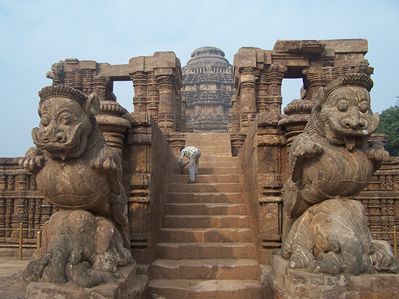
I had heard about the temples of Khujaraho and Konark, where eroticism is mixed with prayers, but I hadn't had an opportunity to visit them so far. So, during my visit to Odisha, when Dr Mani proposed that we make an early morning trip to Konark temple, I was very happy.

The entrance and the first glimpse of the ruins of the sun temple built around 1250 AD under king Narsimha with a tinge of morning mist was breath-taking.


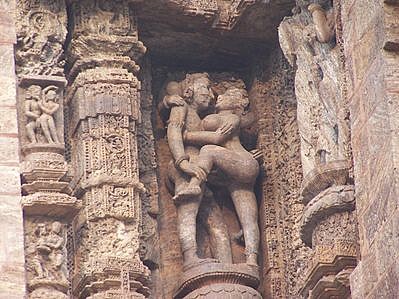
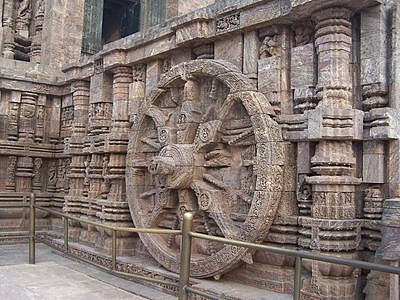
Konark Sun temple and its erotic statues - Images by S. Deepak


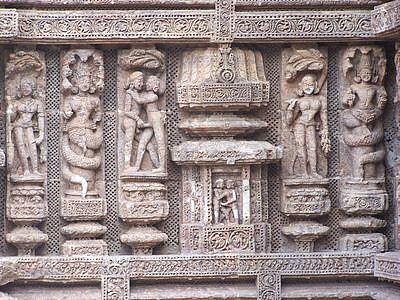
Konark Sun temple and its erotic statues - Images by S. Deepak
 
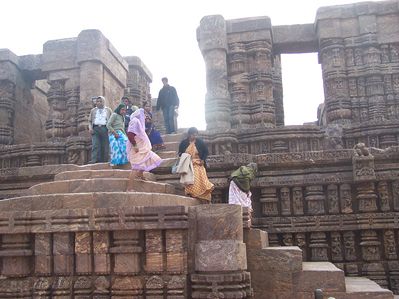
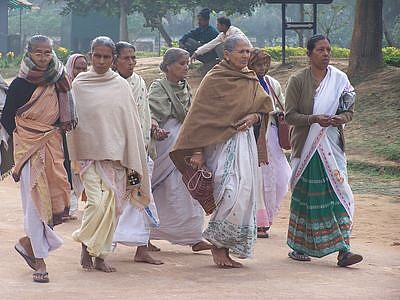
Pilgrims of all sizes and shapes, were every where arriving there in buses, perhaps stopping at Konark on their way to the more famous Jaggannath temple in Puri. 

Pilgrims - Konark Sun temple and its erotic statues - Images by S. Deepak


Pilgrims - Konark Sun temple and its erotic statues - Images by S. Deepak

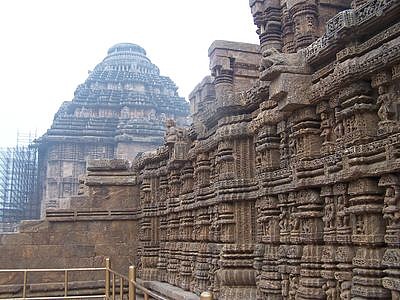
While the beautiful statues at the initial part of the Konark temple are innocuous enough, the main temple building does not leave much doubts about its sexual component with huge erotic sculptures built high up from the ground, around what was the main entrance to the temple. Only if you look carefully you will see a number of smaller erotic sculptures around the big ones.


Konark Sun temple and its erotic statues - Images by S. Deepak


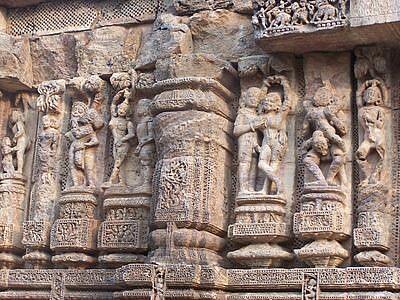
The sidewalls of the temple has smaller statues at eye level, organised in three panels. Most of the lower panels and middle panels do not have erotic sculptures and have more innocuous gods, mythical animals and other figures. Erotic sculptures are mainly in the third level of panels. Dr Mani says that this was done in a way so that children coming to the temple will mainly see non erotic sculptures.


Konark Sun temple and its erotic statues - Images by S. Deepak

The sculptures are very explicit, depicting graphically the different ways of sexual enjoyment. There is oral sex including "69", there are old looking men and women, there are younger looking men and women, mostly couples but sometimes three figures (one man and two women) are also there together looking for orgasm.
 
Thus almost whatever was described in Kamasutra, is expressed here visually in statues. The statues are very life like with expressions of joy and pleasure. At the same time, I think that the artists were asked to make sure that the sexual nature of the statues must be made very explicit and that can explain the unrealistically large penis in most of the statues, that are likely to give a sense of inadequacy to most of the faithful coming to the temple.

Konark Sun temple and its erotic statues - Images by S. Deepak

 
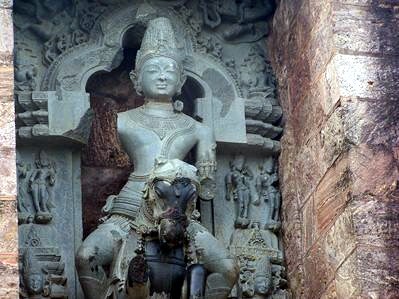
Konark is not just erotic art but is an incredibly beautiful structure. I really liked the three Sun god (Surya) statues, like this one below sitting on a horse.


Sun God - Konark Sun temple and its erotic statues - Images by S. Deepak

The whole temple is made like a chariot with twelve wheels, symbolising the twelve months of the year, pulled by seven horses, representing the seven days of the week. The wheels, the statues, the carvings, the architecture, everything is exquisite.

Konark Sun temple and its erotic statues - Images by S. Deepak


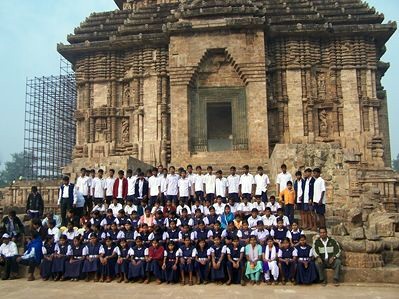
Thinking about the sense of shame usually associated with anything to do with sex, I was wondering about the impact of these erotic statues on the common pilgrims and school students. However, my impression was that barring a few men, who did look towards these panels from a distance, most of the pilgrims kept their heads down and took only fleeting glimpses of the erotic sculptures.


Konark Sun temple and its erotic statues - Images by S. Deepak


Why did those thirteenth century persons make these erotic sculptures in their temples?
 
Was it a period in history when human beings in India had been able to shed off the prude taboos about sex to take a more direct look at life, sex and pleasures? Indian poetry in shringar ras can indeed be very explicit. People worshipping Shiv and Parvati in the form of Shivlings, were they initially more reverential towards the sexual act? Was it something linked to the tantrik marg to realization of God? I don't know the answers to these questions.

While visiting Konark, I had wondered if the statues had also depicted gay or lesbian sex, in terms of understanding the public perception towards these aspects of sexuality in the thirteenth century. Though there was no time to look and analyse each statue (and to be honest, looking at erotic sculptures, after an initial sense of novelty, is a bit monotonous and boring), my conclusion had been that Konark statues are about heterosexual love.

***

Wednesday, 23 January 2008

Describing India - Akbar and Roy

Yesterday M. J. Akbar was in Rome for the release of his new book in Italian "Fratelli di Sangue", or the Blood Brothers. This is how he started his speech:
India is the world’s latest quotation mark. Nepal has become a question mark, Sri Lanka an oversized exclamation mark; and Bangladesh is imprisoned between brackets, the space for leeway decreasing by the day. Pakistan is teetering towards a full stop. China has turned into yesterday’s paragraph: still impressive, but with the contradictions becoming evident through cracks separating sentences.

What a wonderful feeling to be an Indian at that moment in history when the world begins to applaud as India comes within reach of that long-promised tryst with destiny, and shifts imperceptibly towards the centre of the stage
.


And last night, I was reading the article by Amira Hass on Arundhati Roy in the Italian magazine, Internazionale. And, I was thinking about the differences in their view points, between the India described by M. J. Akbar and that described by Arundhati Roy. They do not seem to be talking about the same country.

Arundhati Roy - Picture by Sunil Deepak

Amira is an Isreali journalist, one who lives in Palestine and writes about the Palestinian human rights. I can imagine that she must be seeing and reporting on things and situations that can't be ever described as happy and optimistic. Yet, even she seemed a little afraid of the sense of darkness and doom in Arundhati Roy's words. Or, may be, it was me, reading between the lines and imagining things that are not there.

But it is true, reading Ms. Roy is not easy, especially when we are used to the shining and glowing descriptions of India as exemplified by the words of M. J. Akbar above. Reading Arundhati or listening to her speak, I often feel that she is a very negative person, looking only on negative side of things, yet, I also understand that the unpleasant things she says do have grains of truth in them that we often refuse to acknowledge because they are so unpleasant.

Both Arundhati and Amira were in Ferrara (Italy) for a conference in early October. I had already written about Arundhati's speech in that occasion. She had mentioned about the evening spent with Amira and how much she had enjoyed it. 

Here are a few examples fromAmira's article about Arundhati Roy's views during her interview (my translation from Italian):

"The cruelty, in some way, is hidden by discourses on Gandhi, about the country where everyone meditates and does yoga. Oh yes, everything is going well, we play cricket, we elect Miss world and win Booker prize, we even have dissent, what a beautiful happy family. Instead no. The country is passing through dark and cruel times and you know what I tell you? That if we close our eyes, they will become darker and even more cruel. India does not have scruples of killings. 
A million persons, the Dalits, the untouchables, still work in direct contact with excretions and what is tragic is that they are willing to fight for their right to work with human excretions, because they don't know what other work they can do. Everyday Dalits are lynched but no one accuses the persons responsible for this. In all of India killings of Muslims continue. In the last years 137 thousand farmers have committed suicide. Only in Kashmir, 60 to 80 thousand persons have been killed ...

In the middle of the country, there is a proper civil war going on. Now they have discovered those damned mines of Bauxite in the states of Orissa and Chhattisgarh, that is used for making Aluminium and the multinationals are doing everything to exploit it. You have to see what they are doing, bringing down whole forests, removing hills, deviating rivers, devastating the earth and forcibly evicting the inhabitants..."

Is Arundhati exaggerating or is Akbar talking about illusions? Probably the truth lies a little on both sides. Persons like Arundhati, I guess that it is not so pleasant to listen to them. Like for me. I would rather listen to Akbar any day.

Even Arundhati does not have any illusions about the persons for whom she raises her voice. "If at the end of so many battles, we shall win, the persons whom we are defending, you will see, those same persons will be the ones to first hang people like us on a tree. I am talking about Maoists and Islamists of Kashmir: at times we take sides of persons, who do not have place for us in their imaginations."

This last part of her words was not understandable to me. When we know that they are brutal exploiters, we need to fight for their right and ask that they become in control of people's lives? What does it mean to talk about the rights of Islamists and Maoists that she is advocating? When the butcher is standing next to the goats, he is going to kill, how can she talk of the rights of the butchers?

I feel that Arundhati uses her eloquence and her beautiful words full of raw emotional power to propose something which is opposite of sanity, it is a sickness. 

***** 

Sunday, 20 January 2008

Overdose of writers

It was wonderful to meet so many writers from India, to interact with them, to learn about them as persons and a little bit about their creative way of working, the differences among them, their individuality and their conflicts, their fears, their pet phrases. 

Now I need to be quiet and calm for some time to digest all that I heard and saw.

I spoke to almost all of them individually about their books and writings  (except for Shashi Tharoor, M. J. Akbar and Vikas Swarup). However, I did speak with Shashi Tharoor in the bus-ride as we went to see an opera (Rigoletto).

I had long chat with Bhagwan Dass Morwal right on the first day. With Uday Prakash, there was lot of interaction and somehow, I found myself contradicting him often, perhaps to provoke him! Gayathri Murthy seemed to be familiar right from the first moment, while Nirpal Singh Dhaliwal, initially thought that I won't like him but later, I changed my mind. 

Anita Nayar, M. J. Akbar, Vikas Swarup & Tarun Tejpal - Pic by Sunil Deepak
 

I also had some morning conversations with Tarun Tejpal, Lavanya Shankaran, Anita Nair and Altaf Tyrewalla. I specially liked Altaf. It was also nice to sit with Sudhir Kakkar during a lunch.

One of the most interesting discussions we had was during a lunch break with an Iraqi journalist living in Italy, a Singaporean journalist of Indian origin married in Italy (a coincidence that she knew my sister in Delhi) and Nirpal Singh, a writer of Indian origin living in UK. The discussion about our mixed identities, our roots, our families, our feelings and the absurdities of our worlds, was both moving and challenging.

Apart from Indian writers, it was a wonderful opportunity to meet some of the well known writers from all over the world. I have loved reading books of Luis Sepulveda and Tahar Ben Jaloun and meeting them, listening to them was wonderful.

Some others like Rosetta Loy, Peter Schneider, Bjorn Larsson, Alain Elkann, Gianni Riotta, Lorenzo Mondo, Francesca San Vitale, I knew less well because I had never read their works, but after knowing them, I am going to read them too.

Only Federico Rampini, I missed. I was looking forward to listen to him and to get him sign a copy of his book for me but when he spoke, I was busy giving an interview. Afterwards, when I went out to look for him, he was busy in an interview.

Listening to Prof. Sanpietro and his wonderful wife, Myra as well as Prof. Alessandro Monti was equally rewarding. Interviews, speeches, long lunches, longer dinners, an evening at Rigoletto and meeting so many persons, you can understand my sense of indigestion.

I have recorded many of my discussions with the Indian writers, so perhaps one day I will be finish transcribing all of them for you.

I was introduced in the event as an "Indian blogger-writer living in Italy", which made me feel as if I was not a real writer. However, in the end, we are all writing, so I guess that I can also call myself as a writer!

Sunil Deepak with Uday Prakash, Sudhir Kakkar & Bhagwan Das Morewal


 ***

Thursday, 17 January 2008

Meeting Indian Writers

About a month ago I was contacted by Grinzane Cavour foundation, an organisation based in northern Italian city of Turin that is also involved in promoting translation of literature from other languages into Italian and literary awards. They told me that for their next award ceremony they are planning a two day seminar on Indian literature and writers, and asked for my advice.

My suggestion was that keep a space for persons writing in Indian languages as well, whose works are almost unknown in Europe. Finally this suggestion was accepted and they have kept a small space on writings in Indian languages in which they have invited Uday Prakash, Bahgwan Dass Morwal and Gayathri Murthy. I am also invited to speak in this session.

The remaining authors from India or of Indian origin, are all those who write in English and these include Shashi Tharoor, M.J. Akbar, Tarun Tejpal, Sudhir Kakkar, Anita Nair, Lavanya Shanker, Altaf Tyrewala, Vikas Swarup & Nirpal Singh Dhaliwal.

Some of these authors, I have not read yet. Some others, I tried but did not like their way of writing. However, among the two new writers, I really liked Lavanya Shanker and Altaf Tyrewala.

In the meantime, I was invited to the national radio (Radio Rai 3) along with the Syrian poet and writer Adunis for an interview about the event. I am sorry that I did not know anything about Adunis (real name Ali Ahmad Isbir) before the interview and did not understand the honour it was to be with him (in the image on left). 

This meeting is starting tomorrow. I am very curious to know these well known writers and listen to them. I also hope that I can get some interviews, record their speeches, etc. and then report on this blog.

***** 

Tuesday, 15 January 2008

Violence of Language

I had seen the Colombian writer, Efraim Medina Reyes in Ferrara, a couple of months ago. He had been in a round table with Arundhati Roy, Gofredo Fofi, Elif Shafaq and Laila Lalami. He might have been a good writer but he did not seem to be a very good speaker to me at that time. Or perhaps when he had spoken I was tired and distracted, I don’t know.

I had written about that meeting in this blog in October 2007.

What ever the reason, after that event, from that particular session he was the only writer about whom I was unable to remember anything significant from his speech and that had made me feel a little guilty.

Yesterday I saw an article by him in an Italian magazine, Internazionale. “Il sesso forte”, the stronger sex. The article was apparently about the violence against women. I started reading it and just the first few lines made me sit up. Perhaps I had understood wrongly, I had thought and reread those lines. No, he had actually written what I had thought he had written. The article started thus:

Men kill each other for a variety of reasons. Most of all in their hunger for power and money. Yet, behind every war and aspiration for peace, there is always a soft and hairy cunt.

It was this last part of the phrase that had shaken me awake. Internazionale is an intellectual kind of magazine and though in Italian language people do tend to use equivalent words of fuck, prick and cunt much more liberally than in many other languages, this magazine is considered to be a little on the serious side for that. Thus if they have to use words like this, usually they use words like - having sex, penis and vagina, rather than their more popular counterparts.

I felt that the particular phrase in Medina’s article’s had been put in that particular way to shock the reader. As I read further, it was clear that the whole article was written to shock. It does not mince words and liberally uses words cunt, super-cunt, gang bangs and rapes, almost in every line.

What is there to get shocked, you might well ask. Don’t we all use these words in other contexts? It was this undercurrent of violence that I felt in Medina’s words that disturbed me since apparently he was talking against violence in the world, and especially about violence that especially targets women.

I felt that even while speaking against violence, he expressed himself in very violent terms - violence is not just physical, it is also emotional and psychological and words can be very violent. For example, look at this part of his article (my translation from Italian):

We men can not imagine how terrible it can be for a woman to be forced to have sex. There are still some who think that when a woman refuses to share her cunt with them, actually she is just trying to provoke them. It must be clear that when a woman says no, it means no and you must forget it. I know it is not easy and it must have happened to everyone. But before letting yourself be obsessed by the cunt that has been negated to you, it is better to think of all others that are waiting for you with a smile.

So I had the feeling that he was writing something but his words are conveying exactly the opposite.

And then I was thinking about something else. In literature, in books and magazines, in our daily language, we are all becoming more open in the use of the swear words. In Italy we tend to use these words in way that they become ordinary words, they lose their taboo power. Parents use them in front of children and children use them in front of parents.

Even in some Indian books, magazines and films, it is the same thing. The written and depicted realities tend to reflect the real world in use of these words.

In a way I understand this need. Our bodies and sexuality in general has been too long hidden behind taboos, embarrassments and silences and it is good that those walls can be broken down and we can speak about these parts of our lives more openly.

Yet I have a feeling, Medina’s use of the language is not the answer, that makes our body-parts as mere objects. Sex is not just a mechanics of penetrations and movements.

***** 

Wednesday, 2 January 2008

Coy Subhash Ghai

I was reading an article about the different remakes being planned in Bollywood. These include a remake of Karz, with a new and an original title called Karzzzz. It will be made with our very own nasal heart-throb Himesh Reshmaiyya. It seems that the remake was first proposed to Subhash Ghai, who refused it saying that it will not be correct to remake a film like Karz!

And I was thinking, wasn't Karz "inspired" by "The Reincarnation of Peter Proud"?

So it is ok to remake a Hollywood film in Bollywood but it is not ok to remake that film with other actors?

Perhaps, Hollywood can remake our Karz first, and then we can remake their remake?

Actually, remaking (or making) anything with Reshmayiyya bhaiya sounds like a bad idea to me but then it seems that Bhaiya ji has legions of fans.

*** 

Sunday, 30 December 2007

A frosty magical morning

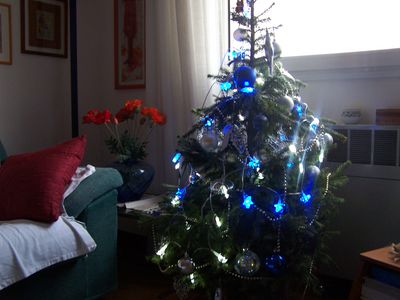
There is something magical about waking up and looking at the twinkling lights of a Christmas tree. This year our tree has ice white and blue lights that are beautiful.

Christmas lights at our home


I looked out of the window and saw that all trees were covered with white frost.

Frost or no frost, if you have a dog you need to go out in the morning so that he can err... shit and piss. I know, the two words, don't rhyme well with Christmas trees and magical ice white and blue lights, but then even on magical mornings, you can't forget the realities of life, can you?

So out we were, I and Brando, shivering together and walking amidst grass that looked like it had been altered with Photoshop. In the part of the park where elderly persons have their handkerchief patches of "kitchen gardens", surviving lettuce, cabbages had been turned into ice-statues by some demon.

Someone had covered their tiny plants with plastic bottles to save them from the frost, they stood up like Milo's Venuses, their arms chopped off by the same demon.

In the end, it was indeed a magical morning.

***


Sunday, 23 December 2007

Jhoom Baraber Jhoom - Film

Finally I saw JBJ, Jhoom Baraber Jhoom.

The film's reviews were so bad and I am not a real fan of any of its stars, so I was not very motivated to watch the film. However the music was wonderful and I kept on listening to the songs. Even after many more newer movies had come and gone, the music of JBJ continues to pulsate in my head even now.

Poster of the film - Jhoom Barabar Jhoom


Plus the negative reviews are actually a plus point, the more negative the reviews, the less expectations I have when I do watch some of those film. This is true up to a point. There are certain films with unbelievable storylines, that good or bad reviews, that I don’t want to watch any way. But for films like JBJ, I think that bad reviews can be good since almost always I end up feeling that the film was not so terrible after all.

That is how I started watching it, ready to doze off while watching it. Yes, I hate to admit it but it seems to happen quite frequently recently, that I doze off while watching some films and my wife swears that I snore louder than the background music of some of these films. So I was there, feeling a little complacent and superior, about the depths the Bollywood film industry has fallen to, sprawled on the sofa in the living room.

Guess what, I never dozed off and on the whole I liked the film. I thought it was a little whacky but it was good fun. I loved Lara Dutta too, especially in the first part of the film, like in the song "Ticket to Bollywood".

I even liked Amitabh Bhacchan, he looks kind of cute and he seems to be enjoying himself.

But I can understand the point of all the critics and aam junta, who didn’t like this film. It is a real nightmare, especially for those defending Bhartiya sanskriti and NRI dreams. The film bulldozes almost all the sacred cows dear to babies fed on mamma Yashraj films’ milk of Raichand families, Rahuls, and Veer-Zaaras. Yes, I know I am mixing my Chopras, Johars and Barjatyas, but I am sure you get point I want to make.

Jhoom Barabar Jhoom is a subsversive film

The film has been packaged as usual YR Films’ dream merchants’ usual masala fare, but actually it is quite subversive and not very subtle about it.

Most of all, it does not respect Indian sensibilities. Probably it has rankled the nuts of our Pakistani brothers as well. One of my feminist friends was telling me that there is nothing like an "attack on our culture" to bring Indians, Pakistanis and Bangladeshis together. While taking care of their errant wives/daughters/sisters, they forget all their other differences. And, this film is an "attack on our culture", no doubts about it. Let me explain myself better.

AB’s baby (Abhishekh Bachchan) as Rikki Thakural, originally from Bhatinda and transplated in Queen’s Engliand, could be a bhaiyya living under madam Mayawati ji, even if occasionally his accent does get English. He is a crook, bumming off magazines and other things from honest shopkeepers (remember Amrish Puri, the stern father of DDLJ?). He could be a Bunty who has run away from Allahabad and landed in UK. No sophistication, no house with the staircase fit for horse-riding, no chandeliers, no private helicopter, no loving mother waiting with aarti ki thali. The character must have been like ice cold showers to all those Bhatindawallas planning to sell off their lands to migrate to the land of milk and honey. I mean, how can you emigrate to the land of the plenty (UK) and continue to be a crook and bhaiyya? What kind of dreams are these?

And, BTW, is Bhatinda the new Jhumaritalaiya? Lot of the heroes and heroines these days are from Bhatinda. Remember Jab We Met and the sikhni, Geet? I bet, it is a ploy to raise up the property prices in Bhatinda, but let me not digress.

Zinta baby’s Alvira Khan (Preity Zinta) is a Pakistani babe who must be the nightmare of all Indian and Pakistani parents, who are losing the desperate fights to keep their children uncorrupted by the decadent values of western culture (if you can call them values and culture!). All those NRIs don’t need to go to cinema to see those nightmares, they live them every day, so why should they watch a movie that revels in glorifying that nightmare? A good Muslim girl does not wear short minis and does not talk with strangers at the Railway station. Not even one burkha scene in the film! Terrible for our Asian culture!

And, the story of love between a Muslim girl and a Hindu boy, it is a serious business. It can be done like in Veer Zaara, but what kind of values are you promoting if you never raise the religion issue in the whole film? Are we trying to say that for love, religion is not important? Terrible, no sharm haya is left in today’s world!

Lara Dutta looks good enough to eat in the first half of the film, but in the second half, her character as the tart Laila is terrible. I mean, we can be understanding about these "fallen" women with loose morals but they must show a bit of remorse for their situation, and they must be willing to cover their heads and coyly ask for maafi, while chanting Hanuman chalisa. However, Laila does not feel any remorse, she uses dirty words, behaves like a slut and then takes a honest mummy-loving dear lad like Satvinder (Bobby Deol) and turns him in to one of those modern kinds who go out with their girl friends without worrying about Bharitiya Sanskriti or their moms.

The film was not given an “adults only” certificate and I am sure that it must have been an insidious but gravely deleterious effect on the morals of our corruptible youngsters. Rightfully it was refused by our intelligent public of NRIs and hopefull NRIs in India.

I hope YR films (and their brothers and sisters in Johar films, Bartajatya films, etc.) have learnt their lesson and are preparing the next episode of Raichand-Rahul saga with half-naked cold-proof heroine dressed in a Bhartiya sari dancing in the Swiss mountains, waiting to cover her head demurely with her sari and touch senior Raichand ji’s feet as his respectful bahu, while celebrating karva chauth. I bet that will be a huge hit.

I the mean time, I am still smiling after finishing towatch JBJ, but then I was already morally corrupted, so that is no big news that I like all these faltu films!

***

This Year's Popular Posts