
Before coming to Assam in the north-east of India, I had never thought of Shiva and Kali as a couple and I had also never thought of the two couples, Shiva & Kali and Krishna & Radha, as having any common stories.
This post is about understanding an aspect of Hinduism - the Shiva-Kali relationship, and the myths connecting them to Radha-Krishna.
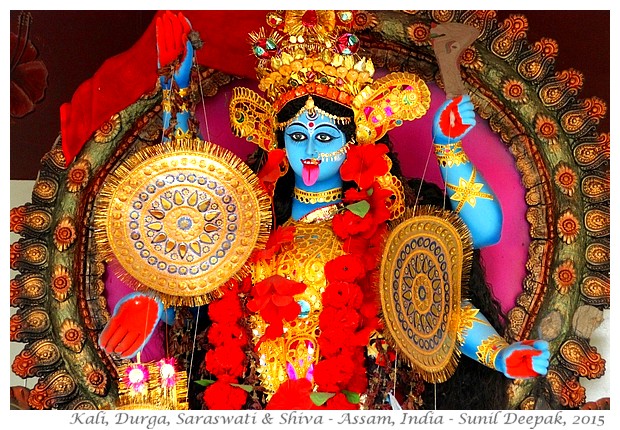
THE TRADITIONS OF GODDESS KALI
I had often wondered how Bengal and Assam can have traditions of two such contrasting goddesses - Saraswati, the peaceful goddess of learning, and Kali, the goddess of vengeance and death. I had always preferred Saraswati.
I found an article of Devdutt Pattanaik explaining the Kali tradition in Hinduism, according to which Kali was initially seen as a demonic force but who was later included in the Hindu mainstream as a "slayer of demons":
“Kali-like goddesses were worshipped by agricultural communities, who were probably matriarchal, who came to be feared by patriarchal nomadic communities… Between the 2nd century BC and 3rd century AD, Kali appears unequivocally for the first time as a goddess in the Kathaka Grihyasutra, a ritualistic text ...
In the Mahabharata and Ramayana which were being composed around this time, goddesses, including Kali, are given more character: they are usually independent and (hence?) wild, appearing as manifestations of divine rage and embodiments of the forces of destructions. ...”
In the Devi Mahatmya, dated roughly to 8th century AD, Kali became a defender against demonic and malevolent forces and by the 19th century, Kali was a goddess of mainstream pantheon ...”
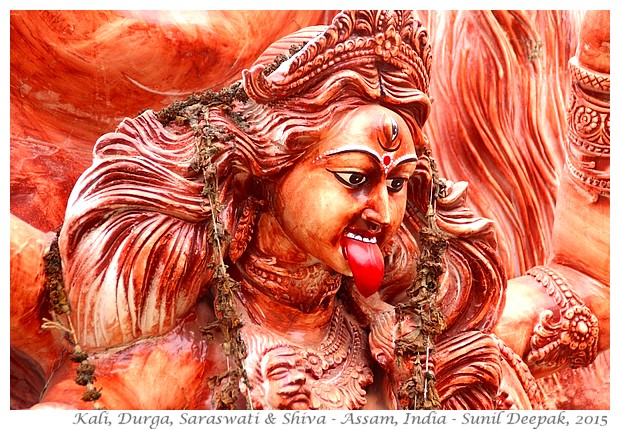
SHIVA AND KALI STATUES IN ASSAM
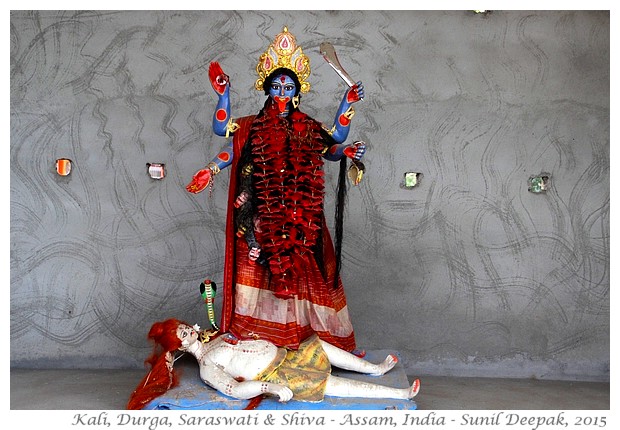
During my stay in Bologna (Italy), I had seen the Durga statues during the annual Durga Puja organised by the local Bengali community, where she is shown standing on the demon king Mahishasur. So when I saw the Kali-Shiva statues, I asked myself, if Shiva was seen like a demon, to be killed by Kali?
Thus, Shiva and Kali relationship was part of Shiva and Shakti relationships that explored different forms of love. As Kali, Shakti expresses herself without inhibitions or need of male approval, and Shiva loves this expression of the female power.
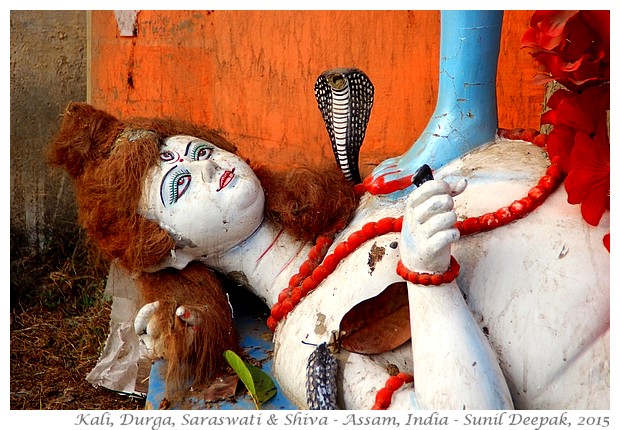
The Two Couples - Shiva-Kali & Krishna-Radha
In Hinduism, these stories have deeper metaphorical meanings which help us reflect about deeper philosophical and spiritual truths. In my understanding, Shiva represents the cosmic consciousness while Kali, as Shakti, the feminine manifestation of the divine, represents the vital energy.
Thus, the Shiva-Kali stories are metaphors about the union of consciousness with the vital life energy.
Shiva is shown as a yogi living alone in the high mountains, while the love of Shakti helps him to become Shanker (or Shankara), the householder.
The story goes that once while Shiva and Kali are making love, Kali wishes to feel what Shiva is feeling. To help Kali understand, Shiva takes the form of the fair Radha, and Kali becomes Krishna.
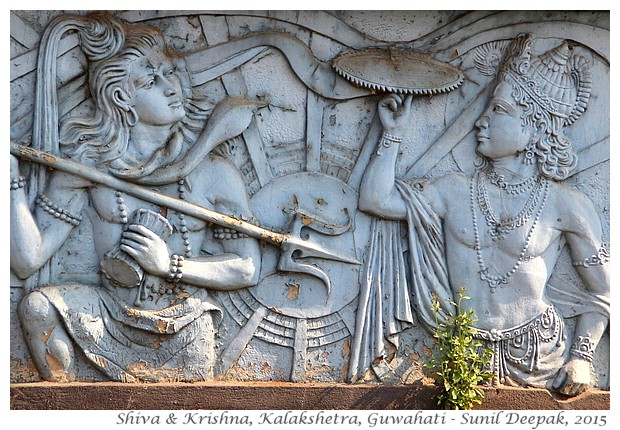
“Just as Kali had made Shiva give up his autonomy and understand the value of the not-so-autonomous other, the pining beloved, Radha helped Krishna understand the limitations of society, the struggle between faith in divinity and fidelity for the husband. Radha was demanding, as Kali once had been. Radha sat on Krishna as Kali stood on Shiva. The two thus mingled and merged in roles and thoughts and feelings. But there was one crucial difference.
Kali had made the wandering hermit, Shiva, into a rooted hermit, Shankara. Radha did the opposite. She remained a flower stuck to the branch of a tree while Krishna became the bee that moves on after getting enriched with nectar. And so fulfilled by Radha’s love, Krishna left Madhuban for Mathura. Kali had revealed love through shringara, romance, as only Krishna can. Radha revealed love through vairagya, renunciation, as only Shiva can.”
CONCLUSIONS
I am glad that my curiosity about the Shiva and Kali statues led me to the different stories and learning about explorations of gender relationships and human sexuality in the Indian myths. Probably most persons when they learn about these myths, even without knowing about the psychological explanations, still internalize an intuitive understanding of the complex and infinite variety of human diversity in Indic traditions.I think that this Shiva-Radha and Kali-Krishna myth is a good example of the traditional Indian way of thinking. These myths are complex and they seem to be telling a truth about gods and human relationships in ways that require an intuitive understanding rather than a rational understanding.
This Indian way of understanding is the way of subjective truths, non linear thinking, where things can have many simultaneous meanings, often contradictory!


Very interesting read, especially the part about the incarnations.
ReplyDeleteThanks Brandan for sharing my interest in the myths. :)
DeleteExcellent article! Thanks for sharin this! Yes Kali temples r here in Odisha too & v also celebrate Kali Puja around Diwali time! My Mom used 2 say abt Kali sticking tongue in repentance, like ur frend said! Lovely rich heritage we have & we mst b inquisitive 2 know more abt our culture!
ReplyDeleteThanks again!
Thanks Amrita for your appreciation. Sometimes the things we take for granted because we are used to them, can be looked at differently by persons who see them for the first time! :)
DeleteAn epic post in this blog and a great article..!
ReplyDeleteOnline Idols Gifts Shopping
Thank you Nidhi :)
DeleteThe best article.
ReplyDeleteThank you Phanikumar for reading this post and for your appreciation :)
Delete"And so fulfilled by Radha’s love, Krishna left Madhuban for Mathura. Kali had revealed love through shringara, romance, as only Krishna can. Radha revealed love through vairagya, renunciation, as only Shiva can.”-This brought tears to my eyes, this what I have always felt internally as though ShivShakti switched their primordial roles as RadhaKrishn to perceive each other's grace in different forms, as a person naturally drawn to shiv,it redirected to radha and I couldnt understand why, But I know now thanks to this
ReplyDeleteThanks friend for this appreciation. I am glad that in a small way I also contributed to your understanding!
Delete