Showing posts with label Mountains. Show all posts

Tuesday, 23 June 2026

A Century of Pasubio War Memorial

The bones-cemetery (Ossario) of the war at the Pasubio mountain near Schio (VI) completes a century this year. Among the different events organised for this anniversary is an exhibition organised at Toaldi-Capra villa in Schio's city centre in June 2026.

The Ossario is about 22 kms from our home and yet it is visible from our terrace, a tiny finger raised up towards the sky at the point where two mountains meet on the horizon. Often, in the morning, when we wake up, we take a look at it to check the day's weather - if it is well visible, or if there is fog denoting humidity or if there are clouds. Thus, it is a kind of personal landmark for us, almost like a family monument.

Ossario & Pasubio War Memorial near Schio (VI), Italy - Image by Sunil Deepak

Let me start this post with a brief background to the battles fought here about a hundred years ago.

First World War in the Pasubio Mountains

Italy joined the first world war in May 1915. Before that, over the past few centuries, this part of Italy known as Alto Vicentino and characterised by Dolomite mountains, had been controlled alternately between the Romans, Vatican (and Austrian-Hungarian empire supporting the Pope) and the Republic of Venice.

When the first world war broke out, the areas north-east to Schio were under Austrian-Hungarian empire, the site where the bones-cemetery was built was also the boundary between Italy and Austria. The Austrian-Hungarian empire lost that war, and the border between Italy and Austria was pushed up to about 175 kms to the north-east.

There were two main sites of battles in this area - Pasubio mountain and the high-plains of Asiago. About a 100,000 soldiers fought at Pasubio and around 10% of them died.

A significant aspect of this war was the building of tunnels inside the mountains, where army officers' offices, ammunition-dumps and hospitals were created. Old mule-tracks were revitalised and new paths were built in the mountains by the soldiers. One famous mountain path, going up along Pasubio had 52 tunnels, all built by soldiers with their own hands and the help of mules.

Ossario & Pasubio War Memorial near Schio (VI), Italy - Image by Sunil Deepak

Construction of the Bones-Cemetery War Memorial

Apart from the war injuries, people also died due to land-slides and extreme cold, especially in winter 1917. Many battles took place in high mountains and narrow mountain passes, difficult to reach. Some bodies were identified and given a burial, but many were not and bodies of the soldiers from the two sides were left in the mountains or buried where ever they were found.

The first idea of creating a war memorial to remember those dead came up in 1917, while the war was going on, when some soldiers asked the bishop of Vicenza for a Madonna statue to be placed inside one of the tunnels. While the Madonna statue was provided, the bishop Ferdinando Rodolfi also started a fund-collection campaign to build a proper monument for the dead. A committee was created for this purpose, at the end of the war, on 3 November 1918.

Original designs of Chemello - Ossario & Pasubio War Memorial near Schio (VI), Italy - Image by Sunil Deepak

Architect Ferruccio Chemello, who had designed the civic theatre of Schio was given this responsibility of designing the monument and a hill known as Bella Vista at an altitude of 1265 metres, at the base of Pasubio mountain was chosen for it (the image above shows some of his designs from the exhibition held in Schio in June 2026). The construction started on 1 July 1920 and it was completed around the end of 1925 and the beginning of 1926.

War Memorial and Bones-Cemetery

The memorial has a 35 metres high quadrangular tower in Romana-Bizantine style, with a massive underground basement used as a cemetery for the bones of about five thousand Italian and Austrian soldiers, some of them have names, others are anonymous.

Ossario & Pasubio War Memorial near Schio (VI), Italy - Image by Sunil Deepak

There is chapel at the base, as one enters the tower, with a Madonna statue by sculptor Giuseppe Zanetti. A staircase goes up to four storeys while all around the walls have frescoes and painted glass-windows with a mix of war and religion related images by the artist Tito Chini (images below).

Madonna sculpture by G Zanetti - Ossario & Pasubio War Memorial near Schio (VI), Italy - Image by Sunil Deepak

Stained glass art by T. Chini - Ossario & Pasubio War Memorial near Schio (VI), Italy - Image by Sunil Deepak

The whole war memorial area is considered as a sacred area and includes a war museum managed by 3 November Foundation near the parking area (image below).

War museum - Ossario & Pasubio War Memorial near Schio (VI), Italy - Image by Sunil Deepak

Near-by Places to Visit

A walking road next to the Pasubio War Memorial takes you to a hanging bridge, also known as Tibetan Bridge, which is decorated with Buddhist flags, with beautiful views of the valley below.

Tibetasn Bridge near Ossario & Pasubio War Memorial near Schio (VI), Italy - Image by Sunil Deepak

Going further along the walking path after the Tibetan bridge one can reach Campo Grosso, known for its spectacular views of the Dolomite mountains.

Walking in the opposite direction towards the Pian delle Fugazze (Fugazze mountain pass) takes you to a popular resting point with the Pasubio bar-restaurant and places like Campo Silvano, Vall'Arsa and Rovereto. I especially love the charming village of Campo Silvano for its spectacular views, an antelope sanctuary and views of a water-reservoir in Vall'Arsa below.

In the End

We try to take all our guests to see the War Memorial because it is a good way to understand local history and for its beautiful views.

One evening at the Pasubio memorial, many years ago, is etched in my memory because of the wonderful colours of the setting sun on the snow-covered mountains with a full moon behind the memorial, as you can see from the image below.

Ossario & Pasubio War Memorial near Schio (VI), Italy - Image by Sunil Deepak

 If this subject interests you, you also might like to read some of my other posts about other war memorials - War Cemeteries of Vicentino; and Remembering Soldiers - War Memorials from Around the World

***** 

Monday, 10 June 2024

War Cemeteries of Vicentino

The First World War was fought between the Austrian-Hungarian empire on the east and the rest of the Europe (and USA) on the west, between 1914-1918.

The tiny town of Schio in north-east part of Italy, where I live, is a part of the Vicentino area around the historical town of Vicenza, and is marked by the little Dolomite mountains of the Alps. Some of the most furious battles of that war were fought in these mountains.

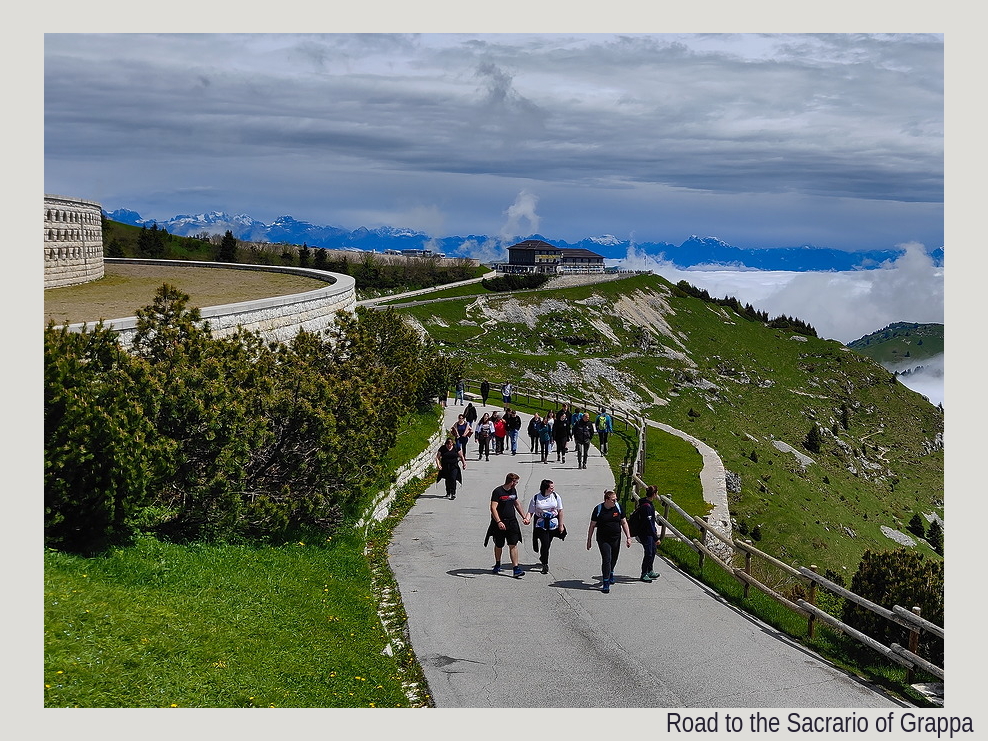
There are three major war monument-cemeteries (known as Sacrario) on these mountains - on Pasubio mountain, on the Altopiano of Asiago and on the Grappa mountain. (In the image below - a view of the top of Grappa Sacrario)

First World War Sacrario at Grappa mountain - Image by Sunil Deepak

Recently, our local book-readers' group decided to visit the war-sites described in a book about the first world war, that we had read. The book written by Paolo Malaguti was titled "Moro della Cima"  (Moro of the mountain top), and it told the story of a man called Moro who used to live at the top of the Grappa mountain and had played a role in the battles around that area.

This post is a result of this visit to the Grappa mountain, at around 1,800 meters, and it briefly presents the three mountain cemeteries.

The Sacrario-Cemeteries

All the towns in this part of the north-east of Italy have their first World War cemeteries, with the tombs of the local boys who had died in that war.

However, around 20 million soldiers had died in that war, thousands of bodies had been lost and many soldiers had not been identified. After the end of the war, for some of them, Sacrarios (sacred monuments) were built in which the remains of a lot of soldiers were put all together.

The Sacrario of Grappa Mountain

The Grappa mountain looms over the town of Bassano. In the battles of Grappa, around half-a-million guys had died and another half-a-million had ended with disabilities. All towns and villages around Grappa have their local monuments to remember those guys and almost every family have relatives who had taken part in that war.

The biggest cemetery is the Sacrario monument at the top of the mountain with thousands of tombs. The monument is divided into two parts - on one side are the Italians and on the other side, are the Austrian-Hungarian tombs.

First World War Sacrario at Grappa mountain - Image by Sunil Deepak

At the top, connecting the two sides, there is a wide-strip of land, from where you can look down at the mountain-slopes. Underneath the monument is a few kilometers long gallery, part of which can be visited, which had a hospital, dining mess and spaces for firing artillery fire on the enemy soldiers.

First World War Sacrario at Grappa mountain - Image by Sunil Deepak

In the Austrian-Hungarian part of the cemetery, there is a tomb of a young boy, which has become a pilgrimage site and is often cited during the calls for peace and against the wars. It is called the tomb of Peter Pan. The blond angelic looking boy's body was found in September 1918 and the Italian soldiers who found him gave him the name, Peter Pan. Later his real identify was discovered, he was from a Hungarian village, which is now part of Romania. People place flowers, sea-shells and stones on his tomb.

Sacrario Grappa - Homage to the Tomb of Peter Pan - Image by Sunil Deepak

Sacrario of Asiago

Asiago is a part of seven municipalities spread over the high-plains of Vicentino region. German-speaking Cimbrian people from the Bavarian region of Germany had settled here. It is a well-known tourist place known for its beautiful mountains, lakes and skiing slopes.

The Sacrario monument of Asiago is a huge construction in the form of an arch at the top of a hill.

First World War Sacrario at Asiago - Image by Sunil Deepak

Sacrario of Pasubio

Pasubio mountain (2,232 meters) looms above Schio, where I live. The mountain pass called Pian delle Fugazze at 1,163 meters, beneath the Pasubio mountain, holds another Sacrario, which I can see from our back-terrace.

The Sacrario looks down from a panoramic point at the Leogra valley and its towns - Sant'Antonio, Valli del Pasubio and Schio.

A short distance below the sacrario, around the edge of the mountains is an old fort (Forte Maso), which was also a site of a furious battle. Walking around Pasubio, one can see smaller monuments remembering specific battles and their soldiers.

Other First World War Buildings

Scattered across these mountains, there are numerous ruins of old buildings, artillery sites, tunnels and caves which were used during the different battles.

One of my favourite such sites is located at a place near Tonezza del Cimone, not far from Schio, with the ruins of bunkers of the Austrian soldiers on a mountain-side. (In the image below)

Ruins from 1st World War in Tonezza del Cimone, Vicentino area, NE Italy - Image by Sunil Deepak

It is such a beautiful place with wonderful views of the surrounding valleys. To think of the war, bombs and people dying in that place, makes me feel very sad, and I cam imagine the lives of those soldiers.

In Conclusion

Let me conclude this post with a picture of some of our book-readers' group-members from the Sacrario of Grappa mountain.

First World War Sacrario at Grappa mountain- Our book-readers' Group - Image by Sunil Deepak

It was a beautiful visit to the top of Grappa mountains. Being together with our book-loving friends was great. Thinking of the world war history and the book we had read, made that history and those events come alive.

These cemeteries have tombs of soldiers from all over Europe, including from UK and USA. The well-known American writer Ernest Hemingway had been an ambulance driver in Schio during that war in 1918. Thus, these sites are pilgrimage places for the families of those soldiers from different countries.

A big thank you to Michela, our readers'-group coordinator, and to Mirko, who was our guide for this visit.

***

#grappa #warcemeteries #firstworldwar #northeastitaly #bookreaders #schiocultura

Saturday, 30 September 2017

A day in the Alpine paradise of Maranza

During our holidays, one day we went to Maranza, high up in the Alps near Italy's border with Austria. It was a beautiful day, and it was  an amazing place with verdant hills and incredible views of alpine valleys and high mountains.

Maranza (Rio di Pusteria, Alto Adige, Italy) - Images by Sunil Deepak

Introduction to Maranza

Maranza is a tiny mountain commune with just 450 inhabitants. It is located in the mountains above the Isarco valley in South Tyrol (Alto Adige) region of north Italy, close to the border with Austria.

Maranza (Rio di Pusteria, Alto Adige, Italy) - Images by Sunil Deepak

We were staying in Rio di Pusteria, 7 km from Maranza. We could have gone up in our car but we preferred to use the cabin-car sky-lift for this journey. If you are staying in a hotel in Rio di Pusteria, you get a free sky-lift pass, and we thought that it would be an opportunity to look at the surroundings from the sky-lift.

Journey to Maranza 

We started after lunch. The cabin-car journey took just 10 minutes. It was a very thrilling ride with amazing views. However, if you are afraid of heights, do not take the sky-lift!

The initial half of the cabin-car journey was sloped at an angle so it passed just above the trees and close to the hills. As we rose up, below we could see the Rio di Pusteria town and the lake.

A view of Rio di Pusteria, Alto Adige, Italy - Images by Sunil Deepak

The second half of journey was almost vertical with breath-taking views of the town below. Some persons were afraid of looking down during this part of the journey. For about 5 minutes, it felt as if we were floating in the air. So if you suffer from acrophobia, you are warned.

Going up in the cabin-car, Maranza (Rio di Pusteria, Alto Adige, Italy) - Images by Sunil Deepak

A walk towards Gitschberg mountain

As we came out of the cabin-car station in Maranza, we found ourselves in an open area. It was a nice and sunny day. We were in high plains with scattered quaint wooden houses with their balconies overflowing with flowers.

Maranza (Rio di Pusteria, Alto Adige, Italy) - Images by Sunil Deepak

To the left was a road going to the San Giacomo church, known for its legend of the three virgin saints. Another road on the right, went towards Gitschberg, the high mountain above Maranza. We took this second road.

Along the road, there were some old wooden farm-houses with barns, like the one in the image below.

An old farm house, Maranza (Rio di Pusteria, Alto Adige, Italy) - Images by Sunil Deepak

The view of the tiny houses filled with flowers across the green hills was beautiful. In one of the hotels below, we could even see a swimming pool with people sitting around in bikinis.

Our walk ended at the cabin-car station, which took the people to the top of the Gitschberg mountain about 800 metres above, almost like the difference between Rio di Pusteria and Maranza.

Gitschberg cabin-car station, Maranza (Rio di Pusteria, Alto Adige, Italy) - Images by Sunil Deepak

In winters these cabin-cars are used for reaching the skiing slopes. In the summer, tourists use them to go up to the mountain for the panoramic views. Our sky-lift free-pass was valid on these cabin-cars as well. However, as we only had that afternoon in Maranza, we decided not to go up to Gitschberg and instead explore the local surroundings.

Cabin-cars to Gitschberg, Maranza (Rio di Pusteria, Alto Adige, Italy) - Images by Sunil Deepak

We found a small family run restaurant near the cabin-car station, where we stopped for a coffee and a delicious cake, while watching the cabin cars going up and down.

A walk on the Panoramic road

In Maranza you have different options for walking and trekking. You can walk to Vals (Valles) and then take the cabin-car to go towards the skiing slopes of Jochtal. It is also possible to follow one of the trekking routes. For example, trekking route n. 16 takes you to Wiersehutte in about an hour and a half. More adventurous persons can take the trekking route to Seefeld lake, which requires about 4 hours of walking and mountain climbing.

Instead, we decided to be more relaxed and take one of the roads going up the hill in front of the cabin-car station - the road was called Via Panorama. With old wooden fences and occasional houses, it was a beautiful road (image below).

Via Panorama, Maranza (Rio di Pusteria, Alto Adige, Italy) - Images by Sunil Deepak

True to its name, Via Panorama also led us to beautiful views of the surrounding Alps as you can see in the image below.

Alp mountains around Maranza (Rio di Pusteria, Alto Adige, Italy) - Images by Sunil Deepak

Below us, to the left we could see the Maranza town and the San Giacomo church. It was an unhurried and relaxing walk. The road did go up and down, but it was not a tough walk.

A view of Maranza (Rio di Pusteria, Alto Adige, Italy) - Images by Sunil Deepak

From Via Panorama, passing through Viccolo Kossler, Via Aigner and Via Aussereck we went all around and came to the San Giacomo church from the back.

San Giacomo church, Maranza (Rio di Pusteria, Alto Adige, Italy) - Images by Sunil Deepak

By this time, there were a few clouds hiding the sun. It felt colder and evening darkness was arriving. We could see some thick white clouds creeping in the valleys below.

A view of the valley, Maranza (Rio di Pusteria, Alto Adige, Italy) - Images by Sunil Deepak

So we decided that it was time for us to go down.We went back to the cabin-car station and took the sky-lift. The journey back to Rio, floating in the sky-lift was as thrilling as it was on the way up.

Conclusions

In my memories, the day spent in Maranza is an ideal holiday - filled with verdant hills, flowers and quaint houses.

I wish that we had more time to visit Gitschberg and Jochtal mountains. Perhaps we will have that opportunity during another holiday!

A weather-vane, Maranza (Rio di Pusteria, Alto Adige, Italy) - Images by Sunil Deepak

I want to close this post with an image (above) of a beautiful weather-vane I saw in Maranza - it has tiny statues of Snow-white and the seven dwarfs. 

***

This Year's Popular Posts